
Does the battery deliver what was promised?
If not: the battery or how it was used? I assess this independently, for electric vehicles and battery storage.
 Dr. Gerald Sammer
Owner, Simotive e.U.
Independent Technical Expert for Electric Vehicles & Battery Energy Storage Systems
Dr. Gerald Sammer
Owner, Simotive e.U.
Independent Technical Expert for Electric Vehicles & Battery Energy Storage Systems
Is your case among these?
Concrete questions from practice, sorted by client. Law firms will find their cases in all three groups. In the initial consultation, we clarify which data exist and how you can obtain them.
Owners, buyers, and lessees will find their case here.
A leased vehicle is returned after four years. A battery test reports 84 percent, and the return report deducts 4,800 euros for it. The lessee considers the deduction unfounded.
- What you get
- An answer on whether the deduction of 4,800 euros is justified.
- What I examine
- Whether 84 percent after four years is normal for this vehicle. That depends on how it was charged and driven.
- What I need
- The battery test, the return report, and the vehicle's charging data.
A dealer sells a used electric vehicle with a battery certificate showing 91 percent. After the first winter, a test reports 83 percent. The buyer sees a defect, the dealer points to the cold and a different test method.
- What you get
- An answer on whether there is a defect or just two tests that do not match.
- What I examine
- Whether the two tests are comparable and what value would be normal after one year.
- What I need
- Both test reports and the charging data since the purchase.
After a software update, every vehicle of a model series charges at only 90 kW instead of 150 kW. The manufacturer calls it battery protection, a consumer association calls it a defect. A litigation funder is asked to finance the class action.
- What you get
- An answer on whether the batteries really need the throttling. You have it before you put money into the proceedings.
- What I examine
- Whether the batteries were already weakening before the update. If not, the cause lies in the software.
- What I need
- Charging data from several vehicles before and after the update.
Vehicle appraisers and claims adjusters bring me in when the battery is at issue.
An electric vehicle fails with a battery fault at 190,000 km, outside the manufacturer's warranty. A used-car warranty is to pay for the replacement, and wear is excluded. The insurer sees wear, the owner a defect.
- What you get
- An answer on whether it is wear or a defect. On that basis you decide whether to pay.
- What I examine
- Whether the whole battery has aged evenly or a single part has failed.
- What I need
- The fault memory, the charging data, and your warranty terms.
A van towing a trailer loses significant power on a climb after roughly 20 minutes. The dealer says it is by design. The buyer says the vehicle was not offered that way.
- What you get
- An answer on whether the vehicle delivers what was promised at the sale. If the fault lies with the manufacturer, you recover the money there.
- What I examine
- Whether the power drops because the vehicle protects itself from overheating, or whether a fault is behind it.
- What I need
- The driving data from the climb, the fault memory, and the sales documents.
A leasing company applies a deduction on return as soon as a battery test is below 85 percent, the same for every model. It sees excessive wear, two lessees see normal ageing. Does the rule hold?
- What you get
- A rule for deductions that holds up in court.
- What I examine
- Which battery value is to be expected for each model under normal use. That shows whether one threshold fits all models.
- What I need
- The test results of your returned vehicles with model, age, and mileage.
A grid-scale storage system sits at 87 percent capacity in its second year of operation. The warranty curve names 92 percent for that year. The supplier points to the operating strategy, the operator points to the battery cells.
- What you get
- An answer on whether the warranty applies.
- What I examine
- Whether the operating strategy explains the missing five percentage points or the cells are weaker than promised.
- What I need
- The operating data of the system and the warranty terms.
Before the investment: the supplier calculates with 8,000 full cycles down to 70 percent remaining capacity and 90 percent round-trip efficiency. Two cycles a day are planned. Does the calculation hold?
- What you get
- A second opinion before you invest. Plus the year in which the warranty actually ends.
- What I examine
- How long the cycles last under your operation. At two cycles a day, 8,000 cycles are used up after eleven years. Many warranties end then. For efficiency, I check whether the system's own consumption is included.
- What I need
- The offer with the supplier's commitments, and your planned operation.
After a shutdown, the manufacturer presents its own analysis and does not release the raw data. Does the analysis hold up?
- What you get
- An answer on whether the analysis holds up. Plus the list of data you should request from the manufacturer.
- What I examine
- I recalculate the manufacturer's analysis and compare it with the contract.
- What I need
- The analysis, the data you already have, and the contract.
What sets me apart
Battery tests and software deliver figures. I assess what a figure means in your case.
With an electric vehicle, the manufacturer says the battery was fast-charged too often. The owner says it was weak from the start. With a storage system, the supplier says the system was used too heavily. The operator says the cells are weaker than promised. I examine independently which claim holds.
Before an investment, the performance figures usually come from the supplier itself. I check them before you sign.
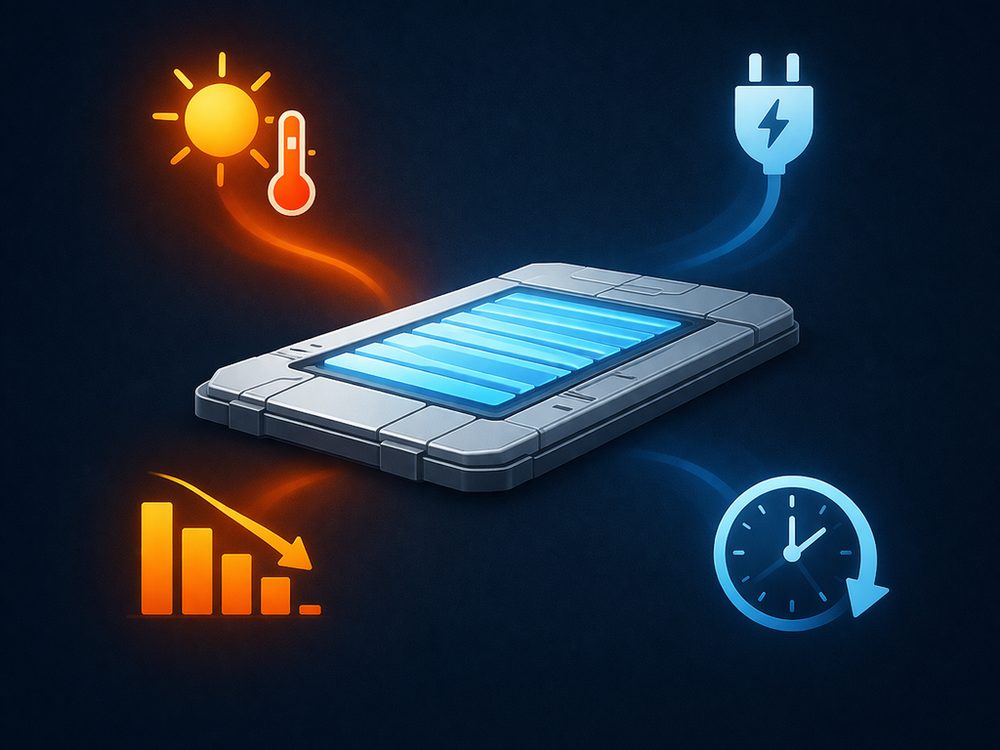
- Independent. I am not tied to any manufacturer, supplier, or software vendor. My product is my expertise.
- Your case, your usage. Most battery tests measure the condition without taking into account how the battery was used. From the physics of the battery, I determine which value is to be expected under exactly this usage. You learn whether the measured value is normal for this use.
- Development experience. I spent 27 years at AVL. Vehicle manufacturers have their powertrains and batteries developed and tested there. I know the manufacturers' data and analyses from my own work.
- Verifiable. My calculation is open. Every step can be checked. The result can be used in court.
One case, step by step
How a measured loss becomes a reasoned finding.
41 percent less range than the data sheet states
22 electric light-duty trucks in a delivery fleet in northern Germany. Since the second winter, drivers have reported sharply declining range. The operator suspects a battery defect, the leasing company holds the usage responsible.
Normal ageing or a defect?
How were the vehicles charged?
Vehicle data and the logs of the charging stations show: the fleet charges mostly at fast chargers, on average 1.2 times a day, often only once the charge level is below 15 percent.
How much should the batteries still store today?
A simulation model knows the battery type and the vehicle, but not the measurements of this fleet. All it learns is how the vehicles were charged and driven and how cold it was in Hamburg. From this, it predicts how much energy the batteries ought to store today. Separately, I determine from the charging logs how much they actually store. I do not rely on the vehicle's own display for this.
Where do the 41 percent come from?
In the model, each influence can be switched off on its own. This shows how much it accounts for.
Settled without court
The report discloses every calculation step. On this basis, the operator and the leasing company reach an agreement. Both are spared a lawsuit.
This is how I work. Do you have a similar case?
Request an initial consultationHow I work
The basis is the data that the vehicle, charging station, or system records anyway. I evaluate it in three steps.
- Capture the usage. I establish how the battery was actually used: how often and how fast it was charged, at which temperatures, and how heavily it was loaded.
- Model the battery. A simulation model reproduces how the battery responds to charging, temperature, and load. I match it against measurements until it reproduces the real behaviour.
- Separate the causes. The model shows which value is to be expected under this usage. If the measurement deviates, I break the deviation down into its causes and quantify each one separately.
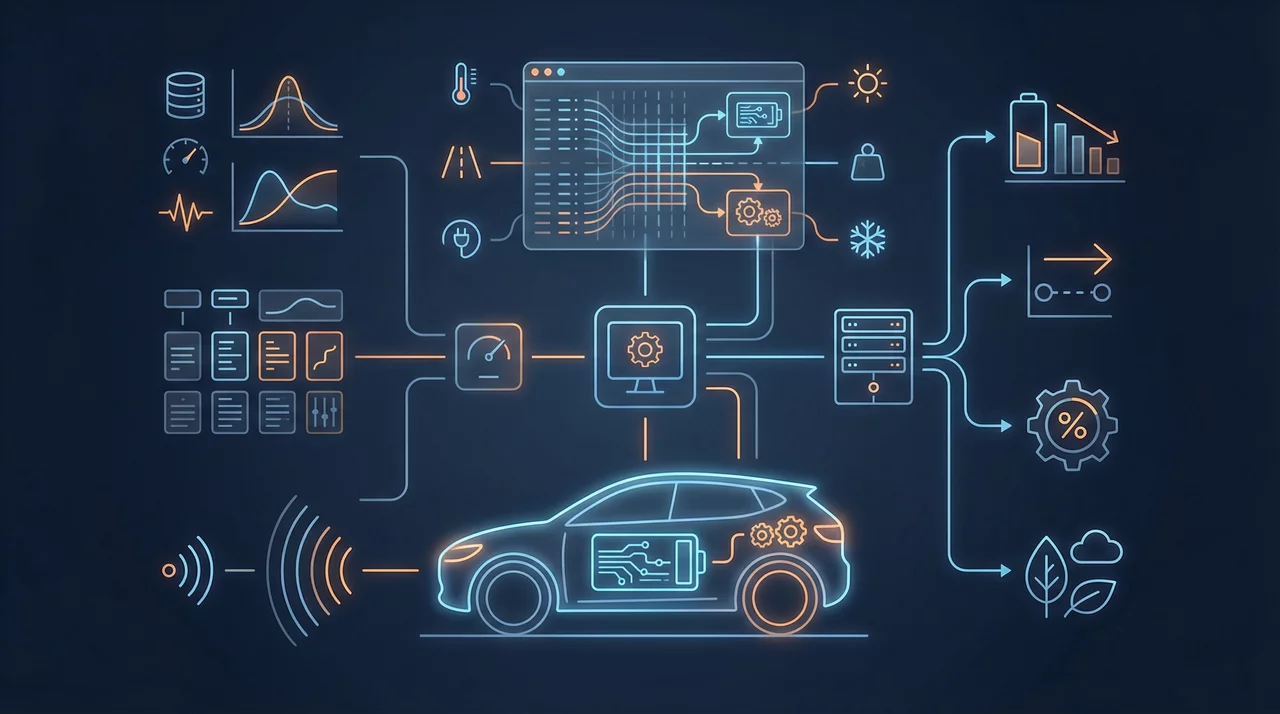
Environment, usage, or battery?
If an electric vehicle falls short on range, the cause is the environment, the way it is used, or the battery, often several at once. Temperature belongs to the environment; route, driving style, and heating, for example, belong to usage. Set the controls. You see how much each influence accounts for on its own.
About
I founded simotive.ai to resolve technically contested cases independently. My work begins where measurement and diagnostics no longer give a clear answer.
- Experience
- 27 years at AVL List GmbH, more than 20 of them in leadership, most recently responsible for the business strategy of batteries and electric powertrains. Alongside that, 15 years until 2026 on the technical steering committee of ASAM, the standardization body of the automotive industry.
- Education
- Dipl.-Ing. in Telematics, TU Graz, with a thesis on artificial intelligence and machine learning. Dr. techn. in Mechanical Engineering and Business Economics with the dissertation "Success Factors for Automotive Testing". Advanced training in battery systems and electric vehicles, TH Ingolstadt 2022.
- Fields
- Battery, battery management, vehicle software, electrified powertrain, and stationary storage systems.
- Speaking
- Regularly at international technical conferences.
Dr. Gerald Sammer
Founder and Managing Director, simotive.ai
Why now
- 29 November 2026. Euro 7 makes battery durability part of type approval. New car types must still deliver 80 percent of their certified energy after five years or 100,000 km, and 72 percent after eight years or 160,000 km.
- 9 December 2026. The new EU Product Liability Directive treats software as a product, introduces disclosure obligations, and eases the burden of proof for claimants. Cases become arguable that previously failed on the evidence.
- 18 February 2027. Electric-vehicle and industrial batteries above 2 kWh need a digital battery passport carrying service-life and condition figures. What it states has to hold.
- Grid-scale storage. By the end of March 2026 Germany had 489 grid-scale systems of 1 MWh or more on the register. In the first quarter of 2026 their additions exceeded home storage for the first time. In Austria the roughly 3.2 GWh installed by mid-2026 still consisted mostly of units below 50 kWh. The warranty cases are still ahead.
Contact
Are you facing a decision with real exposure, an unexplained failure, or a technical dispute? In an initial conversation we establish whether an independent technical analysis helps.
gerald.sammer@simotive.aiFree initial consultation